


Syllabus: GS2/ Governance
Context
- Over the last decade, India has witnessed an inclusive transformation through welfare expansion, and social protection, significantly reducing deprivation and improving the quality of life of vulnerable sections.
What is Inclusive Transformation?
- Inclusive Transformation refers to a development process that ensures the benefits of economic growth, social progress, and public policies reach all sections of society, particularly the poor, marginalized, and vulnerable groups.
- It seeks to improve not only income levels but also access to basic services, opportunities, and human capabilities, thereby reducing social and economic inequalities.
Initiatives for Inclusive Transformation
- Poverty Alleviation and Social Protection:
- Pradhan Mantri Garib Kalyan Anna Yojana (PMGKAY) provides free food grains to over 81 crore beneficiaries.
- One Nation One Ration Card (ONORC) ensures food security for migrant workers.
- Direct Benefit Transfer (DBT) has improved transparency and reduced leakages in welfare delivery.
- Financial Inclusion:
- Pradhan Mantri Jan Dhan Yojana (PMJDY) has expanded banking access to over 58 crore beneficiaries.
- PM Mudra Yojana provides collateral-free loans to micro and small entrepreneurs.
- UPI and Digital Payments have facilitated financial inclusion and digital transactions.
- Healthcare and Nutrition:
- Ayushman Bharat-PMJAY provides health insurance coverage of ₹5 lakh per family.
- Ayushman Bharat Digital Mission promotes digital health records and seamless healthcare access.
- Mission Indradhanush and maternal health schemes improve child and maternal healthcare outcomes.
- Water, Sanitation and Housing:
- Jal Jeevan Mission provides functional household tap water connections.
- Swachh Bharat Mission has achieved near-universal sanitation coverage.
- Pradhan Mantri Awas Yojana (PMAY) promotes affordable housing for urban and rural poor.
- Women Empowerment:
- PM Ujjwala Yojana provides clean cooking fuel to women from poor households.
- Beti Bachao Beti Padhao promotes education, and empowerment of the girl child.
- DAY-NRLM, Lakhpati Didi, and Drone Didi initiatives encourage women-led entrepreneurship.
- Livelihood and Employment Generation:
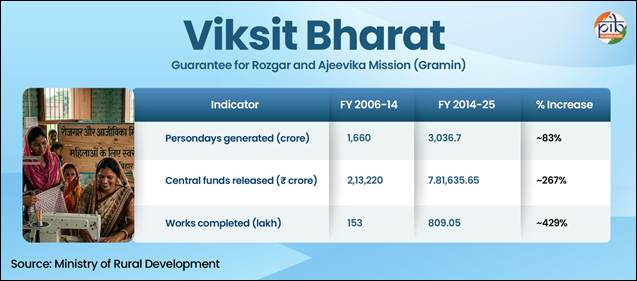
- Viksit Bharat-Rozgar and Ajeevika Mission (formerly MGNREGA) provides wage employment and rural asset creation.
- PM SVANidhi supports street vendors through collateral-free loans.
- PM Vishwakarma strengthens traditional artisans and craftsmen.
- Tribal Development
- Dharti Aaba Janjatiya Gram Utkarsh Abhiyan focuses on holistic tribal development.
- Eklavya Model Residential Schools (EMRS) improve educational access in tribal areas.
Progress Achieved in Inclusive Transformation
- Poverty and Deprivation: Multidimensional poverty declined from 29.17% in 2013-14 to 11.28% in 2022-23, reflecting a reduction of 17.89 percentage points.
- Nearly 25 crore people moved out of multidimensional poverty during this period.
- Water, Sanitation and Basic Amenities: Rural tap water coverage under Jal Jeevan Mission increased from 3.23 crore households (2019) to 15.84 crore households (May 2026), covering 81.87% of rural households.
- Rural sanitation coverage increased from 39% in 2014 to 100% in 2019.
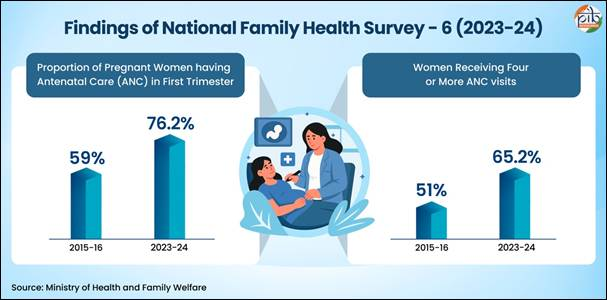
- Improvement in Maternal and Child Health: Maternal Mortality Ratio declined from 130 (2014-16) to 88 (2021-23) per 100,000 live births.
- Clean Energy and Electricity: 10.57 crore free LPG connections were provided under PM Ujjwala Yojana.
- Average rural electricity supply increased from 12.5 hours/day (2014) to 22.6 hours/day (2025).
- Livelihoods and Women-Led Development: Women associated with Self-Help Groups increased from 2.37 crore to 10 crore under DAY-NRLM.
- The number of SHGs increased to 91.75 lakh.
What are the challenges?
- Persistent Regional Disparities: Development outcomes remain uneven across states, districts, and tribal regions.
- Quality Deficit in Public Services: Access has improved, but quality of healthcare, education, and sanitation services remains inconsistent.
- Income Vulnerability: Informal employment continues to dominate the labour market and also job creation has not always kept pace with workforce expansion.
- Nutritional Challenges: Child malnutrition, anaemia, and stunting remain significant concerns.
- Digital Divide: Internet connectivity and digital literacy gaps persist, particularly in remote and tribal areas.
- Social Exclusion: Certain vulnerable groups, including migrants, urban homeless, elderly citizens, and persons with disabilities, continue to face barriers in accessing welfare benefits.
- Fiscal Sustainability: Expanding welfare commitments require sustained fiscal resources and efficient targeting.
Way Ahead
- Strengthen Last-Mile Delivery: Improve beneficiary identification and grievance redressal mechanisms.
- Quality of Services: Shift from infrastructure creation to service quality and outcome-based monitoring.
- Digital Inclusion: Expand broadband connectivity and digital literacy in underserved regions.
- Improve Human Capital: Increase investments in health, nutrition, education, and social protection.
- Strengthen Cooperative Federalism: Encourage greater coordination between the Centre, States, and local governments for effective implementation.
Source: PIB
Previous article
India’s New Bilateral Investment Treaty (BIT) Model
Next article
SIPRI Yearbook 2026
